The Assetizer · 15 February 2024
"We love making the tools that make a difference" – Free download of Chapter 5 of Assetization
Earlier this year, GenTwo's co-founders, Patrick Loepfe and Philippe A. Naegeli, published their first book. In this excerpt, the authors discuss their motivations and the various threads and pathways that led to the genesis of Assetization and the founding of GenTwo.
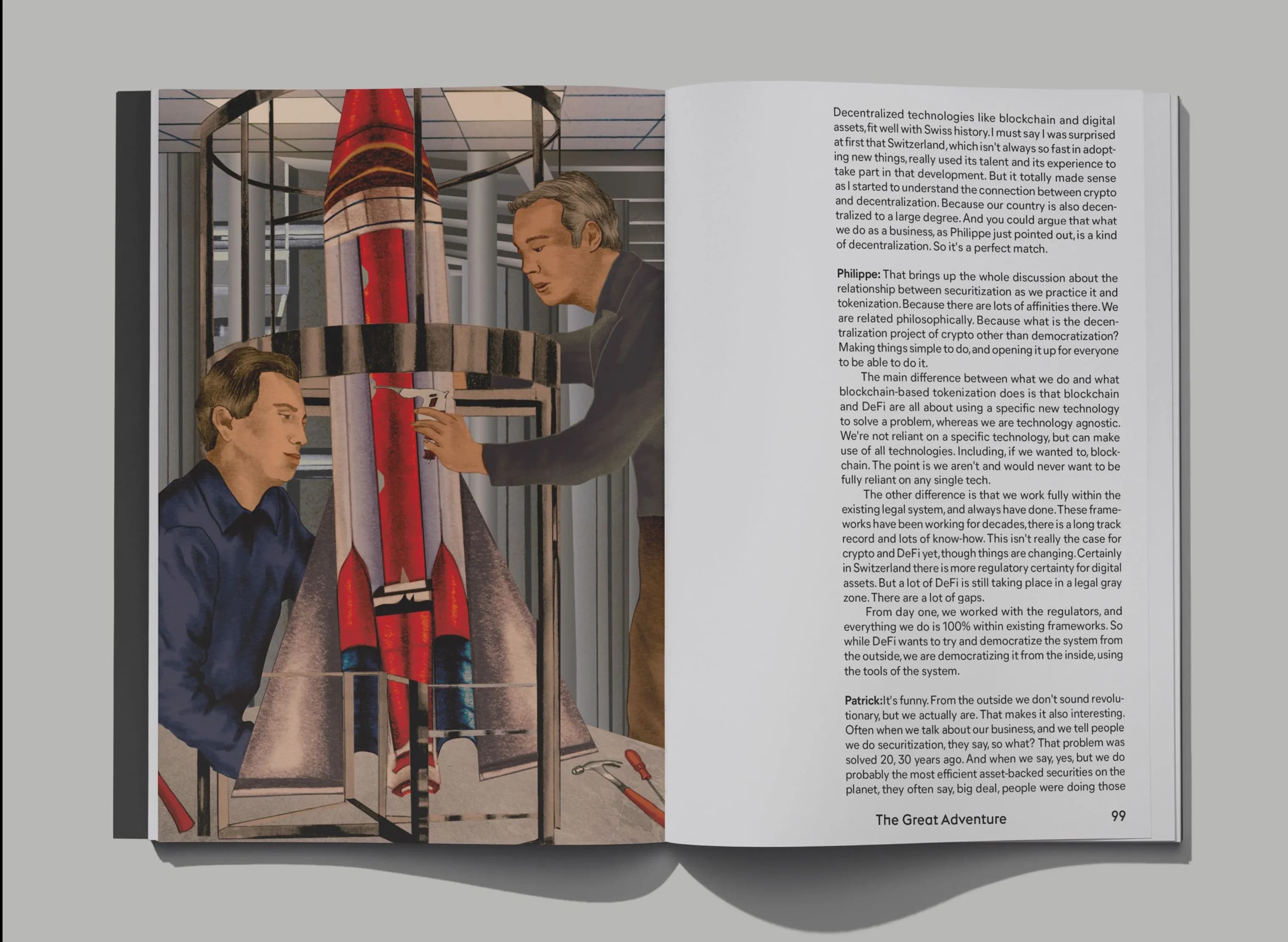
Great companies are often founded on partnerships between individuals. The same can be said of many great books. GenTwo, which turned six years old this month, is the result of the partnership between its two co-founders, Patrick and Philippe. Their new book is a celebration of how far that partnership has come – the story of the birth of a company as well as the tale of the birth of an idea.
Below is an excerpt from Chapter 5, written in QnA format, in which the authors discuss their personal motivations and the genesis of both GenTwo and the idea of Assetization. You can also download the full chapter to read as a PDF.
Patrick and Philippe: you both had distinguished careers in finance before you got together to found your company. What motivates you?
Patrick: I've always been the kind of person who needs to try new things, to solve new problems. I remember before I went to university I was considering a number of courses, and in the end chose mathematics, mostly because I didn't want to do what everybody else was doing, like economics or law. I really enjoyed math. For me, it's a lot about philosophy, asking basic questions. I was also always interested in IT. I remember when my father brought home the first Commodore 64 for his business, I was about 10 years old. And that's how I started coding. It's also how I learned English, because back then all the computer books were in English. ... This theme has followed me throughout my career: finding ways to make things easier, more efficient. And then after achieving it wanting to move on to tackle something else. I like being a pioneer.
Philippe: I'm the opposite of Patrick in many ways. Not the academic type. But I think I'm a fast adapter and can learn very quickly. And I've had the great luck of having many people around me that I could learn from. From my father, for instance, I learned everything about banking, trust and the whole financial industry. He was always a motivation for me. I also connect well with people. And try to build bridges. ... Looking back I think two things really drive me fundamentally. One is the importance of making a difference. The other is a desire to make the tools that help people make that difference. If I'd been alive in the Gold Rush I would have been one of the guys making and selling shovels. I love that: to give people the tools to make things happen.
You have written this book because you want to tell the world about Association. What are the roots of Assetization? Where are the building blocks?
Philippe: We as a business but also our industry have arrived at where we are today because certain things happened. We've learned a lot from the recent past. The dotcom bubble taught us quite a bit, as did the financial crisis, the monetary policies that followed it and the pandemic. So we have a backstory that sort of gives the context of why we saw an opportunity. And I think there are two primary dimensions of that.
On the one hand, there was the increased need for diversification. Because after all the loose monetary policy things had changed a lot. What used to be taken for granted didn't count anymore. For example, when we started, the whole bond allocation as 30%, 40% of a portfolio was gone. And people were desperately searching for performance. And on the flipside, we saw that there was no simpler tool than securitization to help people get that. Other options like funds or GP/LP structures have enormous complexity, with lots of contracts, admin and so on. That adds cost too. We saw an opportunity to bring these things together: diversification and the simple translation into a transaction. It all seemed to align.
Patrick. So you have many players in that ecosystem besides the banks that help connect buyers and sellers. This includes the growing numbers of independent asset managers who moved out of banks because they wanted to give their clients a more personalized service. But they didn't have access to the securitization machinery or the ability to create products. That part of the system wasn't democratized yet. You always had to have the bank and its balance sheet in the middle. And banks just grew bigger and bigger, leading to a great concentration of risk. If the bank fails, the whole thing comes tumbling down. We were reminded again just recently that this is a real possibility. This lack of democratization didn't make sense to us.
A lot of the other parts of the financial system were being democratized. You had democratization of investment advice, you obviously have the funds, ETFs, all of it. We saw a chance to bring this democratization to the smaller asset managers. To broaden access to the machinery. So we felt we were moving with the course of history, so to speak.